

The small light category has evolved significantly from the days of taping LED ribbons to foamcore for quick car interiors or dark corners. Those DIY methods worked, but they lacked precise console control. Today , pocket LEDs have shifted from a luxury to an essential tool on every set. DPs now rely on these tiny sources for precise, surgical placement to wrap a key or add an eye light in tight spaces.
At Geronimo Creek, we spend a lot of time testing these small problem solvers. When a cramped setup cannot accommodate a traditional stand, we regularly reach for four specific fixtures: Aputure MC & MC Pro, Rosco DMG Dash, Astera HydraPanel.
The Hidden Source Philosophy
Before we dive into the specs, it’s worth talking about why these lights matter to a gaffer. In the LA market, we are constantly dealing with “real” locations. We’re in small apartments in Silver Lake or mid-century offices in Century City, where space is at an absolute premium. In these environments, every inch counts.
If I can hide a light behind a book on a shelf, or magnetic-mount it to the underside of a kitchen cabinet without a single piece of grip hardware showing in the frame, I’ve saved the production time and saved the DP’s vision. This “hidden source” philosophy is what has driven the development of these pocket powerhouses.

1. The Aputure MC: The Original Entry
It’s impossible to discuss this category without starting with the original Aputure MC. When it first hit the market, it lowered the barrier to entry for high-quality, app-controllable RGBWW light.
The Use Case:
The original MC is the ultimate “utility” light. It’s small, it’s plastic, and it’s inexpensive enough that you can have a dozen of them in a kit without breaking the bank. At Geronimo Creek, we see these used most often as “disposable” sources—lights you put in harm’s way, like tucked into a car wheel well or hidden in a background where a stray foot might kick it.
The Control:
Sidus Link, a mobile app for controlling lights wirelessly, was a game-changer for the independent side of the industry. Being able to mesh-network a group of these and change colors on the fly from an iPad is incredibly efficient. However, for those of us running professional DMX desks (such as GrandMA, a lighting console, or Blackout, a lighting control software), the original MC can be a bit of a headache because it lacks CRMX (a wireless DMX transmission protocol). You’re stuck in the app world, which doesn’t always play nice with a larger lighting plot.
The Limitations:
Output is the main bottleneck here. It’s an eye light or a background accent; it is rarely a “key” light unless your camera is at a very high ISO. The build quality is also definitely on the “consumer” side. It feels like a gadget, and while it’s tough enough for light duty, it’s not something you want to drop on a concrete warehouse floor.
2. The Aputure MC Pro: The Updated Gem
If the original MC was the prototype, the MC Pro is the professional realization of the concept. This is the “updated gem” that I think has shifted expectations most significantly for what a pocket light can do on a professional set.

Why the “Pro” Matters:
The jump in output is the first thing you’ll notice. Aputure claims it’s about four times brighter than the original, and in our shop testing, the punch is significantly more focused. It uses a tighter beam angle (45 degrees), which is exactly what you want when you’re trying to hide a light. It doesn’t spill everywhere; it goes where you aim it.
The CRMX Factor:
For a gaffer, the addition of LumenRadio CRMX is the single most important update. Being able to link these into the same wireless DMX universe as our SkyPanels and 600ds is a massive relief. It turns the MC Pro from a “stand-alone” gadget into a legitimate part of the lighting system.
Durability and Weathering:
The MC Pro is IP65 rated. While we don’t get much rain or snow in Southern California, we do get dust, the occasional marine layer on the coast, and the high heat of a summer shoot in the Valley. Having a metallic, weatherproof housing means you don’t have to baby it. The magnetic mounting is also much stronger on the Pro, and the accessory kit—which includes grids and diffusers that snap on magnetically—is actually robust enough to stay put during a bumpy car rig.
3. Rosco DMG Dash: The Color Scientist’s Choice
Rosco and DMG Lumiere have always approached lighting from a “color-first” perspective. While other companies might focus on bells and whistles, the Dash is built around the quality of the white light.

The MIX Technology:
The Dash uses a six-chip LED engine: Red, Green, Blue, Amber, Lime, and 4000K White. This is a very different animal from the standard RGBWW found in the Aputures. By using Amber and Lime chips, Rosco can fill in the spectral gaps that often make skin tones look “off” on cheaper LEDs. If you are working with a DP who is a stickler for skin rendition—and most are—the Dash is often the first choice.
The DotRound Accessory:
One of the most popular items used with the Dash is the DotRound. It’s a silicone globe that turns the flat panel into an omnidirectional soft source. It is, quite simply, the best “table lamp” replacement in the business. If you’re on a location with a practical lamp that has a terrible bulb or flicker issues, you can pull the bulb and tuck the Dash with a DotRound inside the shade. It provides a beautiful, even glow that looks completely natural.
Build Quality:
The Dash feels like a piece of cinema equipment. It’s a solid block of aluminum. It has a weight and a tactile quality that suggests it can survive years of professional abuse. It uses the myMIX app, which is intuitive and geared toward professional gel matching. Like the MC Pro, the “Premium” version of the Dash includes CRMX.
4. Astera HydraPanel: The System Powerhouse
Astera has become the industry standard for wireless lighting in LA. The Titan Tube is on almost every truck in town, and the HydraPanel is essentially the Titan’s “square” cousin.

The Titan Engine:
The HydraPanel uses the same Titan LED engine we all know and love. This means the color consistency is world-class. If you use Titan Tubes as your main sources and HydraPanels as your accents, you know the colors will match perfectly. This saves a huge amount of time for the gaffer and the DMX op during the “tweaking” phase of a setup.
Modularity:
One of the unique features of the HydraPanel is its modularity. You can physically link up to four units together to create a larger, 1×1-ish source. It’s designed as part of a system. The back of the unit has a “Touchback” feature that lets you adjust settings and see them reflected in the app instantly, which is a nice touch when you’re standing at the light, and the iPad is 20 feet away.
Beam Shaping:
The HydraPanel comes with a very sophisticated kit of beam-shaping tools (six different modifiers). It behaves more like a “real” light fixture in terms of its ability to be shaped and directed. It is also the brightest of the bunch in terms of raw, usable output, making it a viable option for a primary key in a very tight interview setup.
Comparison Breakdown
When we’re prepping a show at Geronimo Creek, we often look at the data to decide which pocket LED best fits the project’s specific aesthetic. Here’s a look at how they stack up side-by-side.
| Feature | Aputure MC | Aputure MC Pro | Rosco DMG Dash | Astera HydraPanel |
| Output (at 1m) | ~100 Lux | ~400 Lux | ~250 Lux | ~510 Lux |
| Color Engine | RGBWW | RGBWW | MIX (6-Chip) | Titan (RGBMA) |
| Wireless Control | Sidus Link | Sidus / CRMX | myMIX / CRMX | Astera / CRMX |
| IP Rating | N/A | IP65 | IP54 | IP65 |
| Weight | 130g | 225g | 360g | 600g |
| Battery (Max Intensity) | ~1.5 hrs | ~2 hrs | ~3 hrs | ~1.75 hrs |

The “Updated Gem” – Why the MC Pro is the Current Sweet Spot
While the HydraPanel offers the highest output and advanced modularity, and the Dash leads in color accuracy and skin tone rendition, the MC Pro strikes a unique balance. It offers professional-grade output, comprehensive CRMX control, rugged durability, and remains compact enough for easy rigging—traits not equally matched by the heavier HydraPanel or the color-centric but less powerful Dash.
The MC Pro’s 225g weight provides versatile mounting options using minimal tape or magnets, unlike the HydraPanel’s 600g, which adds rigging challenges. Only the MC Pro combines pocket-size form with full DMX compatibility, while the HydraPanel emphasizes output, and the Dash focuses on color and build.
Real-World Scenarios: Choosing Your Light
In our experience at the shop, we’ve seen these lights used in a variety of clever ways. Here’s how I would choose based on the job:
Scenario A: The Car Interior
If you’re rigging a night-driving scene, the Aputure MC Pro is the winner. The magnetic mounting system and the accessory grids allow you to tuck lights into the sun visors or the center console without them being obtrusive. Because they have CRMX, your board op can pulse the light to simulate streetlights as the car moves, all from the safety of the chase van.
Scenario B: The High-End Beauty/Tabletop Spot
When skin tones or product color accuracy is the priority, the Rosco DMG Dash is the tool. The MIX engine’s ability to hit specific gel colors and the softness of the DotRound accessory make it ideal for close-up work where the light needs to be both beautiful and accurate.
Scenario C: The Multi-Light Sync
If you are already running a large-scale Astera plot—maybe with 20 Titan Tubes and 10 Nyx Bulbs—adding HydraPanels makes sense. The ease of grouping them in the Astera App and the sheer consistency of the Titan engine will save you hours of troubleshooting color mismatches.
The Battery Reality
One thing to keep in mind: battery life is always a trade-off. In the fast-paced world of LA production, we rarely run these at 100% intensity for the whole day. However, if you are doing a long night shoot, the DMG Dash consistently outlasts the others in raw battery life at full power.
The MC Pro has an excellent charging case system (available in the 8-light kit) that uses contact pins. It makes the “charging dance” at the end of a shoot day much easier. No more hunting for eight USB-C cables; you just drop them in the slots and walk away.
Final Thoughts from the Shop
The industry is moving faster than ever, and the tools are keeping pace. We’ve come a long way from the days of bulky “small” lights. These four pocket light fixtures represent the best of modern LED technology for the working gaffer.
If you’re building your own kit, don’t just look at the price tag or the lumen count. Think about your workflow.
- Are you already in an ecosystem?
- Do you need to control everything from a console?
- Is color accuracy your top priority, or is it rigging speed?
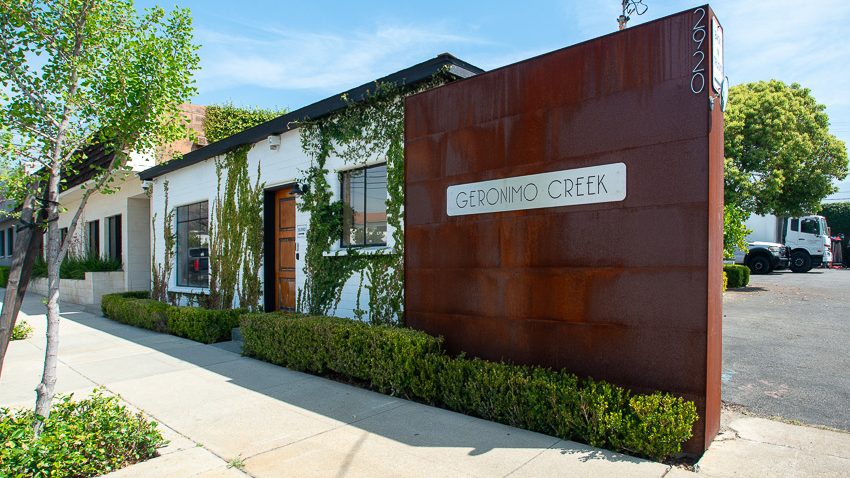
At Geronimo Creek, we stock all of these because we know that no two DPs work the same way. The “right” light is the one that solves the problem in front of you without creating a new one.
If you’re prepping a show in town, swing by the shop. We’ve always got these units out and ready for you to play with. There’s no substitute for seeing how a light renders a face or how it feels in your hand when you’re trying to hide it in a tight spot.
Stay safe on set, keep your rigs tight, and we’ll see you on the next one.